 Dexscreener
 helps identify the token and trading pair before you authorize a swap
Dexscreener supports token address searches that help you match the intended asset to its network and trading pair. Before confirming a trade, carry that identity into the trading interface and inspect the proposed transaction. Check the tokens, spending account, amount, and output conditions before signing. After submission, the transaction record and receiving balance establish what happened. A familiar symbol, matching chart, or wallet notification alone does not establish that you bought the intended token.
Address matching before the wallet request
A token address search is the direct path when you already have the intended asset’s address and network. Compare the complete address in the result with that starting information, then inspect the selected pair. A search that returns an unfamiliar asset or no matching market calls for a different action: revisit the address and network before opening a trade. Choosing a similarly named result would leave the original mismatch unresolved.
Dexscreener supports searches by token name, symbol, token address, and pair address. Those inputs have different purposes. A name helps locate candidates, while an address makes the comparison more precise. A token address identifies the asset; a pair address identifies a particular trading market.
An address confirms a match only against the address you intended to use. Copying an address from an impersonating project preserves the wrong identity perfectly.
The authorization boundary in the trading interface
The trading interface and wallet present the proposed action that needs authorization. Before reaching that boundary, the selected account must support the intended network and hold the required input asset. Network transaction costs also need funding under the chosen execution method. A token balance on another network does not satisfy that requirement.
Permissions and execution requests
A wallet request can authorize token access or execute a trade. Read the action itself, because a successful permission request does not establish that a swap occurred.
Token spending permission
In allowance-based token systems, an approval gives a specified spender permission to use a specified token, subject to an allowance. Inspect the spender and amount before authorizing access. A broad allowance can remain relevant after the immediate trade, so its scope deserves separate attention from the amount entered in the swap form.
Swap authorization
A swap request should correspond to the intended account, network, input asset, and output asset. Inspect the amount being spent and any output protection that the execution method exposes. The precise review fields vary across wallets and trading interfaces; a button label alone cannot establish which operation you are authorizing.
Rejecting an unsigned request preserves the opportunity to correct it. Submission changes that position: a pending transaction may support a cancellation attempt, depending on the network and wallet, but success is uncertain. Closing the trading page does not cancel a submitted transaction. Confirmed transactions cannot simply be reversed through the wallet.
Different ways to locate and check the intended market
Search results and token records help identify the asset and market; quotes describe the proposed exchange amounts and conditions. Choose the method that matches the information you have. None replaces inspection of the eventual authorization request.
| Method | Starting information | Useful result | Main limitation |
|---|---|---|---|
| Name search | Token name | Candidate trading pairs | Matching names do not establish identical tokens |
| Symbol search | Token ticker | Pairs associated with that search term | Different tokens can share a symbol |
| Token address search | Complete token address and intended network | Markets associated with the token | The starting address may identify the wrong asset |
| Pair address search | Complete pair address and intended network | A particular trading pair | A pair address is different from a token address |
| Explorer token lookup | Token address on the relevant network | The corresponding blockchain token record | A record’s existence does not establish project legitimacy |
| Trading interface quote | Selected assets and input amount | Proposed exchange amounts and available conditions | The quote can change before execution |
The market data distinguishes the network, pair address, and addresses of the pair’s constituent tokens. Preserve those distinctions when moving between a chart and a trading interface. Matching only the displayed ticker discards information that the market record provides.
The quote for the amount you intend to trade
A swap quote applies to a particular input amount and execution path. The price displayed beside a chart does not describe every possible trade size. Available liquidity, the pools used, and trading costs affect the proposed output. Inspect the amount that the quote expects to deliver, rather than treating the chart’s price as an executable offer.
For swaps with a fixed input amount, a minimum-output condition places a lower bound on the amount the transaction may deliver. A swap that enforces a minimum output reverts if execution cannot satisfy that bound. The condition protects the encoded token amount. It does not establish that the selected token is authentic or that its market price is reasonable.
A refreshed quote deserves another review when its output or conditions change. Raising the permitted price movement expands the range of outcomes you authorize; it does not correct a wrong token address.
Transaction records and the receiving balance
A transaction identifier connects a submitted request with its blockchain record. The record should belong to the expected network and account. Its status distinguishes a pending request from a completed or failed operation, while its details establish which action occurred. A successful approval record, for instance, confirms permission rather than receipt of the output token.
A wallet can fail to display a token even when the blockchain record shows that the account holds it. Token detection and the selected network can explain that discrepancy. The relevant comparison uses the actual token quantity and address, rather than a wallet’s estimated currency value.
An absent balance is therefore insufficient evidence for submitting another trade. Establish the original transaction’s status first. If the transaction confirms receipt, check the account’s current token balance on a block explorer for the intended network. If that balance includes the token but the wallet does not display it, check the wallet’s selected network and token detection settings. If the transaction remains pending, a second submission could create an additional trade rather than repair the first one.
Price impact and slippage at the final review
Price impact describes the price change caused by the trade itself. The relationship between trade size and available liquidity determines how strongly execution moves through the pool’s prices. Slippage describes the difference between an expected execution price and the price obtained as conditions change. These concepts explain different reasons that the output may differ from a simple chart-price calculation.
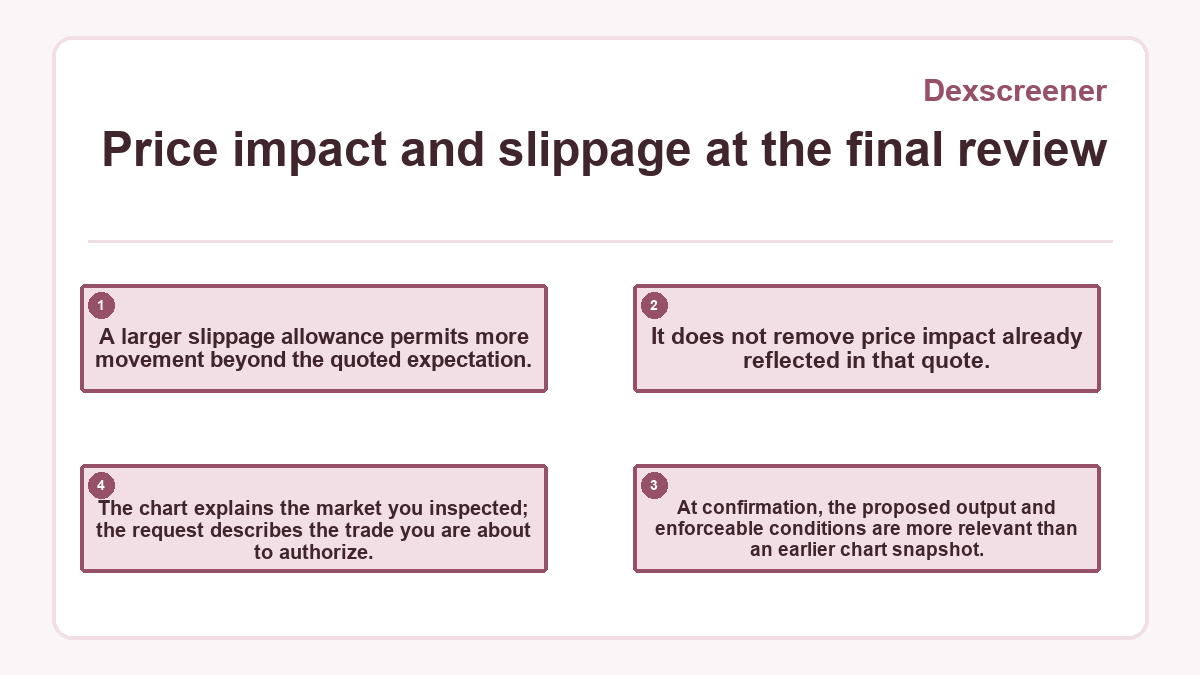
A larger slippage allowance permits more movement beyond the quoted expectation. It does not remove price impact already reflected in that quote. At confirmation, the proposed output and enforceable conditions are more relevant than an earlier chart snapshot. The chart explains the market you inspected; the request describes the trade you are about to authorize.
Dexscreener - your questions answered
Is an abbreviated token address enough to check before signing?
An abbreviated address is insufficient for a complete identity comparison. Matching the visible beginning and ending leaves the omitted characters unchecked. Expand or copy the full address, and compare it on the intended network. A familiar symbol or logo cannot resolve a difference in the underlying address.
Why does an address search return no pair before a trade?
An empty result means the search did not locate a matching indexed pair; it does not prove that the token is absent from the blockchain. Check whether the input is a token address or pair address, and confirm the intended network. Do not substitute a similarly named token to bypass the missing result.
Should a token verification page ask for my recovery phrase?
A token verification page has no legitimate need for your recovery phrase or private key. Those credentials control wallet assets, while token identification uses public addresses and network information. A request to reveal them during a pre-trade check is a reason to stop that interaction.
Does a lower wallet currency value mean I received fewer tokens?
A lower currency estimate does not by itself establish that fewer tokens arrived. Compare the actual token quantity in the receiving account with the transaction details. Currency estimates depend on pricing information, so two interfaces can present different valuations without showing different token balances.
Are network costs returned when a swap fails?
An executed transaction that fails can still consume network fees, even though the swap does not complete. That differs from rejecting an unsigned wallet request, which submits no transaction. Check whether the failure occurred before submission or during blockchain execution before interpreting a balance deduction.
Updated